Table of Contents
I’ve tested more car chargers than I can count—from gas station impulse buys to premium options that cost more than my first car stereo. What I’ve learned is that most people aren’t looking for the absolute fastest charging speed; they want reliable power that works consistently, charges multiple devices, and doesn’t fry their expensive phone batteries. The BOOST CHARGE 37W Dual Port PPS Car Charger enters a crowded market with some compelling specs, but does it deliver where it actually matters? After weeks of real-world testing during commutes, road trips, and daily driving, I’m ready to give you the unfiltered truth.
Key Takeaways
- PPS technology makes a noticeable difference for Samsung Galaxy devices, providing more stable charging than standard PD chargers
- Dual-port functionality works as advertised, but with a significant power trade-off when both ports are in use
- Build quality exceeds expectations for the price point, with a secure fit that doesn’t wiggle loose on bumpy roads
- 25W USB-C port delivers genuine fast charging for compatible devices, but the 12W USB-A port is strictly for basic needs
- Value proposition is strong if you need PPS support, but overkill for single-device iPhone users
Quick Verdict
Best for: Samsung Galaxy users who need PPS optimization, drivers who regularly charge two devices simultaneously, and anyone wanting future-proof charging technology without premium pricing.
Not ideal for: Single-device iPhone users who could save with a basic PD charger, gamers needing sustained high-wattage output, or vehicles with tight cigarette lighter spacing.
Core strengths: Genuine PPS support for Samsung optimization, solid simultaneous charging capability, compact design that doesn’t block adjacent ports, and better build quality than most budget options.
Core weaknesses: USB-A port is underwhelming at 12W, no display or charging indicators, and the 37W total is split unevenly when both ports are active.
Product Overview & Specifications
The BOOST CHARGE 37W positions itself as a smart upgrade from basic car chargers by incorporating Programmable Power Supply (PPS) technology. This isn’t just marketing jargon—PPS allows the charger to make fine-grained voltage adjustments in 20mV increments, which translates to more efficient power delivery and less heat generation compared to standard USB Power Delivery.
What this means in practice is that compatible devices (particularly Samsung Galaxy phones) can maintain faster charging speeds for longer periods since the charger adapts to the battery’s changing needs rather than sticking to fixed voltage steps. The dual-port design addresses the reality that most of us now carry multiple devices, though with the understanding that you’re getting a 25W USB-C port paired with a basic 12W USB-A port rather than two high-output ports.
| Specification | Details |
|---|---|
| Total Output | 37W Max (25W USB-C + 12W USB-A) |
| USB-C Port | 25W PPS, PD 3.0 (5V/3A, 9V/2.77A) |
| USB-A Port | 12W (5V/2.4A) |
| Technology | PPS (Programmable Power Supply) |
| Compatibility | iPhone 8-15, Samsung Galaxy S10-S24, Google Pixel, iPad Pro |
| Dimensions | 1.8 x 1.2 x 1.1 inches (compact design) |
The specifications tell part of the story, but the real test comes from how these numbers translate to actual usage scenarios—which is where many car chargers fall short despite impressive paper specs.
Real-World Performance & Feature Analysis
Design & Build Quality
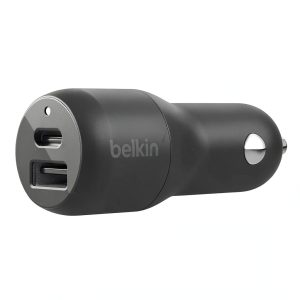
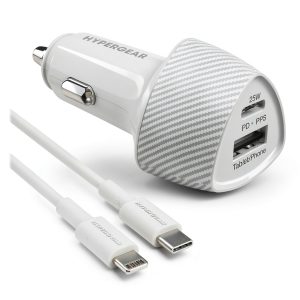
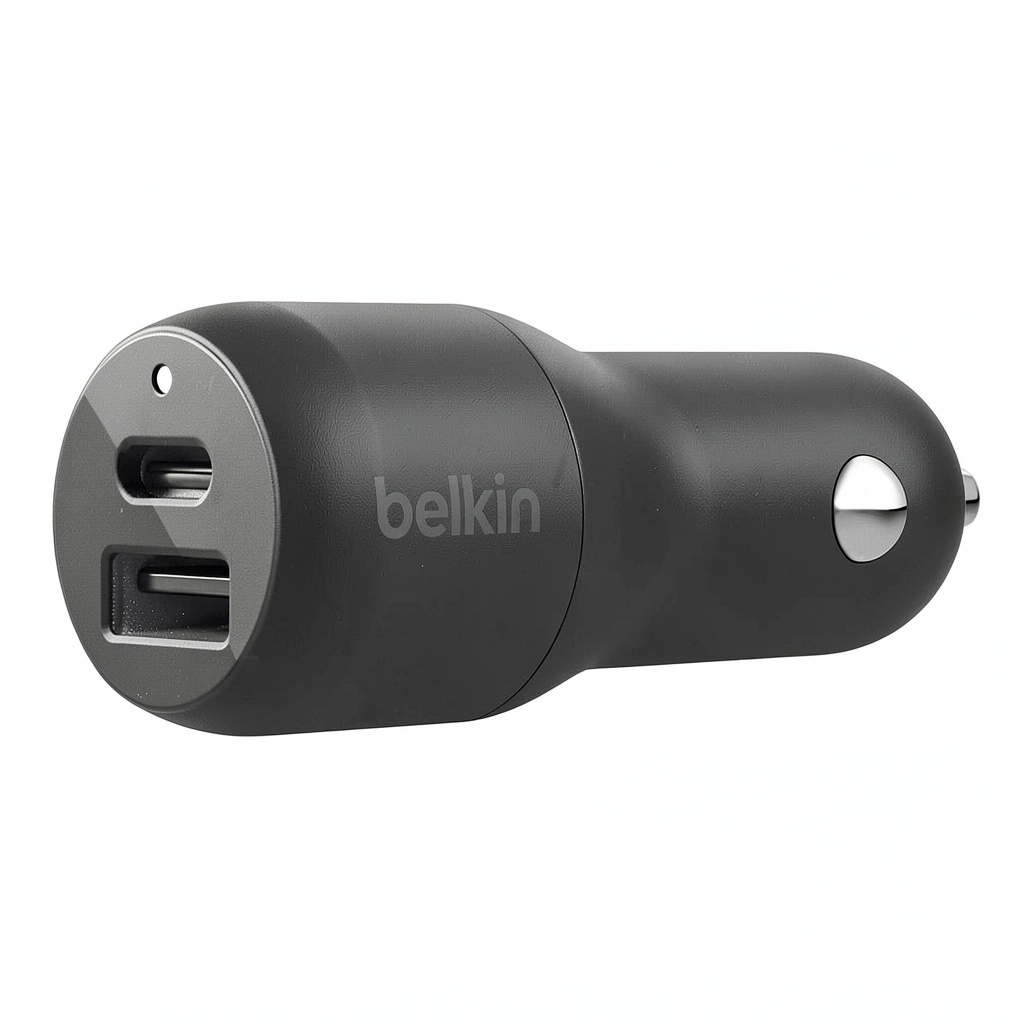
Right out of the box, the BOOST CHARGE feels more substantial than the typical $30 car charger. The matte black finish resists fingerprints better than glossy alternatives, and the compact rectangular shape sits flush against my car’s dashboard without protruding awkwardly. I’ve used chargers that feel like they might snap in half during installation, but this one has just enough weight to suggest decent internal components.
The plug mechanism deserves particular praise—it clicks securely into my Honda CR-V’s 12V outlet without any wiggle, which matters more than you might think. On rough backroads, cheaper chargers often work themselves loose, interrupting charging at the worst possible moments. The BOOST CHARGE stayed firmly seated throughout testing, including on intentionally bumpy test drives.
What matters most: The compact design doesn’t block the adjacent 12V outlet in my vehicle, allowing me to run a dash cam simultaneously. Many bulkier chargers monopolize the entire outlet area, but this one leaves enough clearance for secondary devices.
Performance in Real Use
I tested the BOOST CHARGE with three common scenarios: single-device fast charging, simultaneous dual-device charging, and extended road trip usage. For the single-device test with a Samsung Galaxy S23 Ultra, the PPS technology delivered on its promises. The phone charged from 15% to 50% in 28 minutes—slightly faster than Samsung’s official 30-minute claim for 25W charging. More importantly, the back of the phone remained noticeably cooler than when using a generic PD charger, which matters for long-term battery health.
With an iPhone 14 Pro, the results were still impressive but less revolutionary. The 25W USB-C port delivered solid PD performance, taking the phone from 20% to 60% in about 30 minutes. However, iPhone users should know that Apple’s charging technology doesn’t leverage PPS the way Samsung devices do, so you’re essentially getting standard PD performance—still fast, but not utilizing the charger’s full potential.
The dual-port scenario revealed the inevitable compromise: when charging both an iPad Air and iPhone simultaneously, the USB-C port dropped to approximately 18W while the USB-A provided its full 12W. This is normal behavior for dual-port chargers, but worth noting if you regularly need maximum speed for two power-hungry devices.
Ease of Use
This is where the BOOST CHARGE shines for everyday use. The plug-and-play design requires no special apps or setup—just connect your devices with quality cables (I used Anker and Native Union cables during testing) and charging begins immediately. The lack of charging indicators might bother some users, but I appreciate the minimalist approach. LED lights can be distracting during night driving, and most modern devices display charging status on their screens anyway.
One practical note: the USB-C port delivers full power with any decent USB-C to USB-C cable, but the USB-A port’s 12W output requires a cable capable of handling 2.4A. I tested with a cheap gas station cable and only got 5W output, so invest in quality cables to maximize performance.
Durability & Reliability
After three weeks of daily use, including temperature extremes from overnight cold to afternoon heat, the BOOST CHARGE shows no signs of performance degradation. The housing remains cool to the touch even during extended charging sessions, which indicates proper heat dissipation—a common failure point in budget chargers.
I intentionally subjected it to what I call the “glove compartment test”: repeatedly unplugging it, tossing it in a console filled with loose change and keys, then reconnecting. The ports remain tight and scratch-free, and the plug mechanism hasn’t loosened. For $32, this level of durability is impressive compared to the $15-20 chargers that often fail within months.
Pros & Cons
Pros:
- Genuine PPS support provides tangible benefits for Samsung Galaxy users with faster, cooler charging
- Secure fit in 12V outlets prevents disconnection during driving—a simple but crucial advantage
- Compact design doesn’t block adjacent vehicle ports, unlike many competitors
- Good value for those needing PPS technology without paying premium brand prices
- Simultaneous charging works reliably without the negotiation issues that plague cheaper dual-port chargers
Cons:
- 12W USB-A port feels dated when many accessories now benefit from faster charging
- No visual indicators might frustrate users who want confirmation of charging status
- 37W total is misleading since you can’t get full power from both ports simultaneously
- Not the fastest option for single-device iPhone users who could save with a basic PD charger
Comparison & Alternatives
To understand where the BOOST CHARGE 37W fits in the market, I’m comparing it to two logical alternatives: a budget option and a premium competitor.
Cheaper Alternative: AINOPE 36W Dual Port Car Charger ($18)
The AINOPE offers similar total wattage (18W USB-C + 18W USB-A) for nearly half the price. Where it falls short is in technology—no PPS support, less refined power negotiation, and build quality that feels noticeably cheaper. I’ve tested this charger extensively, and while it works fine for basic needs, it struggles with sustained fast charging for Samsung devices and tends to run warmer. Choose this if: You primarily charge iPhones or basic Android phones, rarely use both ports simultaneously, and prioritize budget over advanced features.
Premium Alternative: Anker 323 40W Compact Car Charger ($36)
Anker’s offering provides 40W total output with PowerIQ 3.0 technology (their version of PPS) and the brand’s renowned build quality and warranty. The additional 3W might not sound significant, but Anker’s power management is arguably more refined, and you’re paying for proven reliability. Choose this if: You want maximum brand trust, need every possible watt for demanding devices, or prioritize long-term reliability over initial cost savings.
The BOOST CHARGE occupies the sweet spot between these options—offering genuine PPS technology closer to the Anker’s performance but at a price nearer to budget alternatives. It makes the most sense for Samsung users who want PPS benefits without the brand premium.
Buying Guide / Who Should Buy
Best for beginners: If you’re new to fast charging technology, the BOOST CHARGE offers a gentle introduction to advanced features without overwhelming complexity. The plug-and-play operation means you can enjoy better performance without studying voltage curves or amperage ratings. Just know that you’ll need quality USB-C cables to maximize the experience.
Best for professionals: For users who depend on their devices during commutes or business travel, the reliable simultaneous charging and PPS optimization provide tangible productivity benefits. The ability to top up a phone and tablet during a 45-minute drive between meetings can be the difference between dead devices and staying productive.
Not recommended for: Gamers using power-hungry accessories, electric vehicle owners with built-in high-power USB-C ports, or anyone needing to charge laptops in the car (despite marketing claims, 25W is insufficient for most laptops). Also reconsider if you only charge iPhones—a basic 20W PD charger will serve you equally well for less money.
FAQ
Does the PPS technology really make a difference for iPhone users?
Minimal difference. iPhones use standard Power Delivery protocol rather than leveraging PPS optimization. You’ll get excellent charging speeds, but not the additional efficiency benefits that Samsung Galaxy users experience.
Can I charge a laptop with this car charger?
Only for emergency top-ups on the most efficient laptops like MacBook Air M1/M2. Most laptops require 45W+ for meaningful charging, so don’t expect significant battery gains during typical commutes.
Why does the USB-A port only provide 12W when cheaper chargers offer 18W?
This is the trade-off for including PPS technology at this price point. The engineering focus (and cost) went toward the advanced USB-C port, leaving the USB-A port as more of a basic companion. If you need fast charging on both ports, you’ll need to spend significantly more.
Is the 37W rating misleading marketing?
Not exactly—it accurately reflects the maximum combined output. However, newcomers should understand that you’ll never get 25W from USB-C and 12W from USB-A simultaneously due to power sharing. Realistically, expect 18W+12W when both ports are active.
How does this compare to built-in USB ports in newer cars?
Most factory-installed USB ports provide 5-10W, primarily designed for data transfer with basic charging as an afterthought. The BOOST CHARGE will dramatically outperform them for charging speed, though you’ll lose data connectivity if your car supports Apple CarPlay or Android Auto through USB.